

Utilizing a USB startup key with BitLocker on Home windows 11 provides an additional layer of safety by requiring each your PC’s TPM and a bodily USB drive earlier than Home windows can boot. This information walks you thru making a BitLocker USB startup key from scratch on Home windows 11 Professional or Enterprise, plus a number of simpler third‑social gathering alternate options.
What a USB startup secret is
A BitLocker USB startup secret is a small key file saved on a USB flash drive that BitLocker reads throughout boot to unlock your system drive. On trendy PCs with a Trusted Platform Module (TPM), BitLocker usually unlocks the drive robotically, however including a USB startup key successfully turns it into two‑issue authentication at startup.
That is completely different from:
A USB safety key (FIDO2/YubiKey), which is used for passwordless signal‑in to accounts and companies like Microsoft accounts and Home windows Good day.
A easy password, which will be guessed or stolen extra simply than one thing you bodily plug into your PC.
With a USB startup key configured, your PC is not going to boot into Home windows except that USB drive is inserted throughout startup.
Necessities and essential notes
Earlier than you begin, ensure your setup meets these primary necessities.
Home windows version:
You have to be operating Home windows 11 Professional, Enterprise, or Schooling to make use of full BitLocker; Home windows 11 Dwelling solely gives Machine Encryption and doesn’t assist this actual technique.
{Hardware} and firmware:
Your PC ought to have a TPM 1.2 or later (most Home windows 11‑prepared gadgets do), since this information makes use of “TPM and startup key” safety.
Drives:
A system drive (normally C:) that you would be able to encrypt with BitLocker.
A spare USB flash drive to behave because the startup key; it doesn’t should be giant, but it surely ought to be dependable and devoted to this process.
Additionally consider:
All the time again up your BitLocker restoration key someplace protected (Microsoft account, one other drive, printout) in case you lose the USB startup key.
For those who lose each the USB startup key and the restoration key, you may completely lose entry to your knowledge.
Step 1: Activate BitLocker in your system drive

First, you want BitLocker enabled on the system drive the place Home windows is put in.
Open File Explorer and go to This PC.
Proper‑click on your system drive (normally C:), then choose Activate BitLocker.
Comply with the BitLocker setup wizard:
Select the way to again up your restoration key (Microsoft account, file, or printout).
Select how a lot of the drive to encrypt (for a more moderen PC, “Encrypt used disk area solely” is usually quicker).
Select the encryption mode (for Home windows 11 gadgets that gained’t be moved to older programs, use the newer “XTS‑AES” default).
Click on Begin encrypting and let the method full; this could take a number of minutes or longer relying on drive dimension.
As soon as BitLocker is totally enabled, your system drive shall be encrypted and usually unlocked robotically by the TPM at boot.
Step 2: Configure Group Coverage to require a USB startup key
 Subsequent, it is advisable inform Home windows that BitLocker is allowed to make use of a TPM plus a USB startup key at boot.
Press Win + R, kind gpedit.msc, and press Enter to open Native Group Coverage Editor.
Within the left pane, navigate to:
Pc Configuration
Administrative Templates
Home windows Parts
BitLocker Drive Encryption
Working System Drives
In the suitable pane, double‑click on Require further authentication at startup. 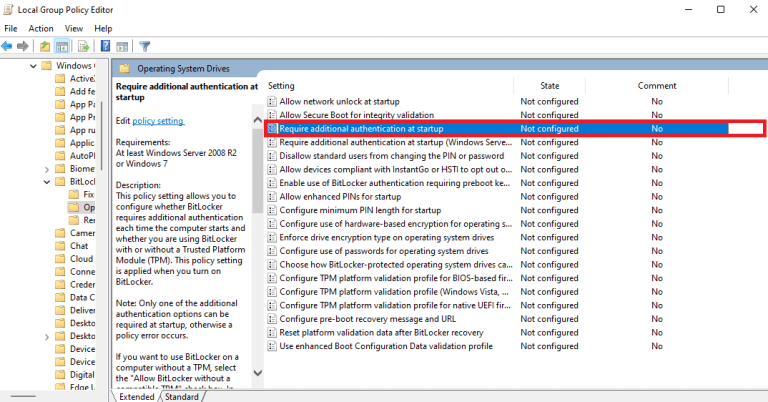
Within the coverage window:
Set it to Enabled.
Underneath the choices space, search for Configure TPM startup key (or related).
From the drop‑down, select Require startup key with TPM so BitLocker expects each the TPM and a USB key at boot.
Click on Apply, then OK, and shut Native Group Coverage Editor.
This coverage change permits the BitLocker engine to connect a “TPM and startup key” protector to your working system drive.
Step 3: Create the USB startup key with handle‑bde
With BitLocker enabled and coverage set, now you can add the USB startup key protector utilizing the manage-bde command‑line device.
Insert the USB flash drive you need to use as your startup key and observe its drive letter (for instance, E:).
Click on Begin, kind cmd, proper‑click on Command Immediate, and select Run as administrator.
Instance:
System drive: C:
USB drive: E:
Within the elevated Command Immediate window, run this command, changing the letters with your individual:
manage-bde -protectors -add C: -TPMAndStartupKey E:
This tells BitLocker so as to add a TPM and startup key protector to drive C:, saving the startup key file on the USB drive at E:.
After you press Enter, it is best to see a affirmation {that a} new key protector was added for the working system drive.
Behind the scenes, manage-bde -protectors -add manages the BitLocker safety strategies and the -TPMAndStartupKey swap provides a mixed TPM plus USB startup key protector. For those who select the improper drive letters right here, BitLocker might write the startup key to the improper USB or goal the improper system drive, so double‑verify earlier than operating the command.
Step 4: Check your USB startup key
As soon as the protector is added, it’s time to check that your new startup key works.
Go away the USB startup key plugged in and restart your PC.
Your pc ought to boot usually into Home windows with the USB drive related, with BitLocker silently unlocking the system drive by TPM plus the USB key.
Shut down the PC once more, take away the USB startup key, and energy it again on.
This time, your PC ought to cease at a BitLocker display screen and refuse in addition into Home windows till the USB startup secret is inserted or a sound restoration secret is entered.
If this conduct happens, your USB startup secret is working appropriately and your PC now successfully requires “one thing you might have” (the USB) plus “one thing you’re / one thing within the machine” (TPM) to begin.
Third‑social gathering instruments to lock your PC with a USB drive
If BitLocker and Group Coverage really feel too complicated, there are a number of third‑social gathering apps that allow you to use a USB drive to lock and unlock your PC after Home windows has already booted. These don’t change BitLocker disk encryption, however they’ll add a handy lock layer on high of Home windows.
USB Raptor

USB Raptor is a free utility that may flip virtually any USB flash drive right into a key that locks your PC when eliminated and unlocks it when inserted, so long as this system is operating.
When the PC is locked by USB Raptor, a customized lock display screen seems and customers can unlock utilizing the USB key, a password, or community unlock, relying on configuration.
One downside is that USB Raptor have to be operating and appropriately configured in your system for the lock conduct to work, so it’s extra of a session lock device than a boot‑time protector.
Predator
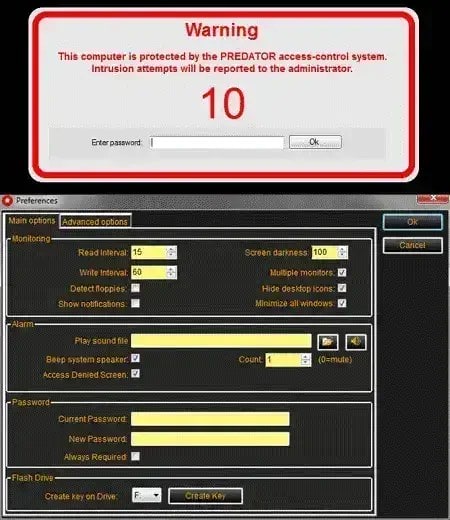
Predator is a low‑value safety device that makes use of a USB flash drive as a key; when the USB is eliminated, the PC is locked and customers see an “Entry Denied”‑fashion message as a substitute of the conventional desktop.
It repeatedly displays whether or not the USB secret is current and blocks entry if the bottom line is lacking, making it appropriate for shared PCs or small workplaces that desire a easy bodily lock.
Predator focuses on locking entry whereas Home windows is operating somewhat than controlling full‑disk encryption like BitLocker.
Rohos Logon Key

Rohos Logon Key converts a USB flash drive right into a safe logon key that may change or complement your Home windows password with two‑issue authentication (USB plus PIN).
It helps options like emergency logon, Protected Mode safety, and the power to assign a number of USB keys per consumer account, and it’s obtainable for each Home windows and macOS.
Though Rohos gives a freeware mode, continued use past the trial interval requires shopping for a license, sometimes as much as round $59 relying on version.
Utilizing a USB startup key with BitLocker on Home windows 11 is a sensible strategy to harden your machine towards unauthorized entry, particularly on laptops or desktops that retailer delicate work or private knowledge.
If you mix TPM‑primarily based safety with a bodily USB key, you make it considerably tougher for somebody in addition your PC and entry your information, even when they handle to steal the {hardware} or take away the drive. This setup does add a little bit of complexity to your boot course of, however for a lot of customers the commerce‑off in comfort is value the additional peace of thoughts, significantly in shared, cell, or enterprise environments.
On the similar time, it is very important deal with your USB startup key like another vital safety issue: hold a spare drive prepared, retailer your BitLocker restoration key someplace protected, and keep away from leaving the USB key plugged in if you find yourself away out of your PC for lengthy intervals.
Utilizing third‑social gathering instruments resembling USB Raptor, Predator, or Rohos Logon Key can additional improve your safety by including a session lock or logon‑degree safety on high of BitLocker, however they need to complement, not change, full‑disk encryption. Whether or not you stick with the constructed‑in BitLocker technique or pair it with these utilities, the objective is similar: ensure your Home windows 11 machine solely unlocks for you, with a safety setup that matches your danger degree and your every day workflow.


 Users Today : 0
 Users Yesterday : 0
 This Month : 0
 This Year : 96140
![Is Tesla Chasing Short-Term Profits Ahead of Long-Term Loyalty? [Opinion]](https://i2.wp.com/www.notateslaapp.com/img/containers/article_images/giga-factories/2-million-fremont-factory.jpg/8c4ab26062de6f1d20059680199f57c9/2-million-fremont-factory.jpg?w=120&resize=120,86&ssl=1 "Is Tesla Chasing Short-Term Profits Ahead of Long-Term Loyalty? [Opinion]")


